Police, civil servants top in bribery cases in new EACC report
Police officers, civil registration officials, and transport regulators are among the public servants most frequently implicated in bribery cases.
Police officers, civil registration officials, and transport regulators are among the public servants most frequently implicated in bribery cases.
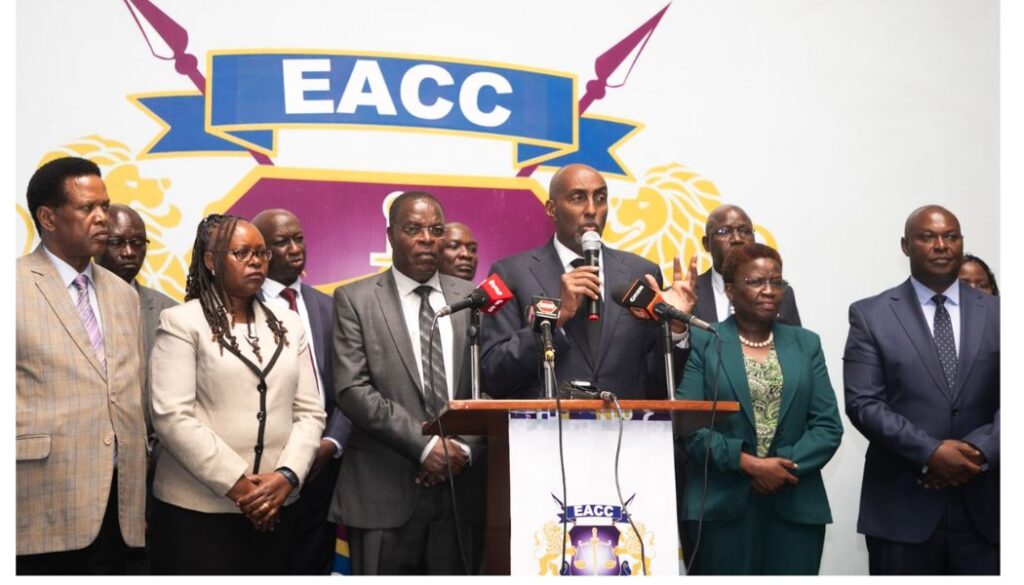
This is according to a new national survey conducted by the Ethics and Anti-Corruption Commission (EACC).
The findings were released on April 9 during the launch of the National Gender and Corruption Survey 2025, which highlights how ordinary citizens interact with public officers when seeking essential services across the country.
The survey shows that in the 12 months preceding the study, 35.5 per cent of service seekers reported having given a bribe to police officers, making the National Police Service the most frequently bribed institution among those surveyed.
Civil registration officials followed at 30.0 per cent, while officers from the National Transport and Safety Authority recorded 25.4 per cent. Land registry officers were cited at 23.3 per cent, and registration of persons officers at 21.2 per cent.
Other public service points also registered notable bribery levels. Immigration officers stood at 18.2 per cent, tax and revenue officers at 13.1 per cent, prosecutors at 11.7 per cent, and magistrates at 8.7 per cent.
Public utility officers were cited at 7.8 per cent, while other unspecified civil servants recorded 6.9 per cent. Judges were mentioned at 5.5 per cent.
The survey further indicates that corruption perceptions extend into social services and governance structures, albeit at relatively lower rates.
High Court stops Senate from summoning governors
Body of missing man recovered from deep pit in Kisii
EPRA warns oil marketers of Ksh.10M fines over fuel hoarding, price hikes
Three people dead, six rescued after building collapses in Highrise area of Kibera
Health workers such as doctors, nurses, and midwives were cited at 4.8 per cent, while elected county representatives recorded 2.4 per cent.
Other health workers also stood at 2.4 per cent, teachers and lecturers in public institutions at 2.2 per cent, and Members of Parliament and legislators at 2.1 per cent.
The study was conducted through a collaboration involving the EACC, the United Nations Office on Drugs and Crime – Regional Office in Eastern Africa (UNODC-ROEA), the National Gender and Equality Commission (NGEC), the Kenya National Bureau of Statistics (KNBS), and Transparency International Kenya.
Researchers examined citizens’ experiences in accessing public services across all 47 counties.
Data was collected using household questionnaires administered through face-to-face Computer-Assisted Personal Interviewing (CAPI), targeting a nationally representative sample of adults aged 18 years and above.
The survey covered 1,467 clusters distributed proportionately across the country based on the 2019 national census. Out of 22,005 sampled households, 21,941 were successfully reached, with 16,858 households completing interviews.
Government announces crackdown on lenders using national IDs as collateral
Gachagua is warming up for a Ruto handshake; Wamuchomba claims
Thika Road Mall addresses alleged reports of sale
Wattanga nominated envoy to South Africa immediately after exit from KRA
Follow us